| St. Anthony's Church
(1859-1880)
Eight years after Port Townsend's founding by Alfred Plummer, the
first church edifice ever built was that of our Catholic parish. Begun
by a missionary, Father Louis Rossi, in 1859, the site was in Point
Hudson at Jackson and Water Streets. A simple building, it neighbored
the Charles Hotel.
![[St. Anthony's Church]](1859.jpg) St. Anthony's Church1859-1880
St. Anthony's Church1859-1880
St. Anthony's first resident pastor, Father Prefontaine, arrived in
1864, remaining for three years before transferring to Seattle (he was
so loved in Seattle that a fountain was later named to honor his
memory). 1877 brought the acquisition of our Parish Cemetery on San Juan
Avenue, followed by the arrival of Father Regis Maniouloux in 1880. For
the next forty years he led our parish to new heights, but oddly enough,
during that time, the seeds of our destruction were being planted and
they would ultimately shake the very foundations of our parish, both
figuratively and literally.
St. Mary Star of the Sea(1881-1919)
Two lots at the corner of Taylor and Franklin Streets became
available for his use, so in 1882 Father Maniouloux, with money borrowed
from his relatives in France, there built a new church, renamed it St.
Mary Star of the Sea, and furnished it with several fine French made
statues. He also persuaded two French nuns, his own sister, Sister
Emmanuel, and a cousin, Sister Madeline, to join him in Port Townsend.
Both nuns served faithfully until their deaths. A rectory was built next
to the church (it still stands, restored to much the way it looked at
the turn of the century).
![[The first St. Mary's Church]](1881.jpg) The first St. Mary's Church(1881-1919)
The first St. Mary's Church(1881-1919)
Around 1912, Father Maniouloux's niece, Jeanne Bessy, arrived from
France to serve as housekeeper. Although she was strongly anti-Catholic,
her uncle kept her in line, but only up until his death in 1919 (his
grave is located in our parish cemetery). His possessions, which
included the church, rectory, and furnishings, reverted to his heir,
niece Jeanne Bessy. Miss Bessy's first order of business was to lock the
parishioners out of the church. She demanded $10,000 not to foreclose on
the mortgage. She was offered $5,000, which she refused, and foreclosed.
Enraged, she smashed the French made statues and sold the stained glass,
vestments and vessels. The church was demolished and a storage building
was erected from the salvaged lumber. Church items which were unable to
be sold remained there and deteriorated due to a leaky roof. In 1933,
the parishioners finally retrieved the church records for $85. By 1940,
Miss Bessy, on State relief for a number of years, lost the church in
lieu of overdue taxes. William Daly, a local attorney, arranged for the
remaining statues to be returned to the parish.
Addison Lewis, a local non-Catholic and friend of the then pastor,
Father McGrath, restored the statues, without charge. Two of the five
statues, one of St. Anthony, were donated to another parish. The
remaining three are in our current church (Our Lady and St. Joseph with
Infant on either side of the altar, and Our Lady of Dolors, in the
vestibule).
St. Mary Star of the Sea(1919-1945)
After the church property was foreclosed upon, Mass was celebrated in
the Odd Fellows' Hall on Lawrence Street for several months until the
old Swedish Methodist Church on Blaine and Pierce Streets was purchased
for $250. A house diagonally across the street was purchased to serve as
the rectory and both structures were in very poor condition. At the same
time, Father Frederick Klein was named pastor. His sister, Francesca,
arrived from Germany to serve as housekeeper. Over the next several
years dissension started to grow. In 1929 Father Klein thought building
a school might help foster cooperation so he purchased property for
$2,300 which over the next ten years devalued to just $500, angering
parishioners even more. Father Klein, discouraged and suffering from
arthritis and other ailments brought on by the dampness and drafts
inherent in the poor structures of the church and rectory, resigned and
returned to Germany in 1932. There he continued to serve mankind, in
particular the Jews who were being persecuted under Adolf Hitler. He was
ultimately sentenced to a concentration camp for his acts and died there
in 1939. His sister, Francesca, married Henry Neumann, and they remained
in Port Townsend until their deaths.
Father Peter Smythe replaced Father Klein and parish dissension
continued to flourish, to the degree that protest meetings were held in
town and delegates visited the Diocese to submit many petty charges.
Father Smythe developed arthritis because of the continuing poor
condition of the parish buildings, and in 1935 resigned from the parish.
![[1919-1949]](1919.jpg) St. Mary Star of the Sea(1919-1949)
St. Mary Star of the Sea(1919-1949)
Enter Father Dillon, who found the parish in deplorable condition,
both spiritually and materially. Winds sweeping through the church made
it impossible to keep the altar candles lit and the faithful were forced
to remain well bundled throughout Mass. A wood stove heated the church
and the walls and ceilings were filthy. Ragged curtains covered the
windows and the kneeling benches were splintered and broken. Even the
vestments were filled with mold. As a result, at his first Mass, Father
Dillon announced that until the church was cleaned, no further Masses
would be said there. In the rectory, winds would raise the rugs from the
floors and the coal stove smoked so badly, Father Dillon would often be
forced outside and into the cold. He too began to suffer from arthritis.
Spiritually, the parish was in even worse condition. The majority of
parishioners failed to attend Mass and had fallen away. The rebellious
spirit of some of the remaining parishioners continued as they
threatened to "fire" their pastor. He decided to respond by "tightening
the reins" and took steps to enforce the rules of canon law, even
forbidding the choir to sing any music not specifically designated by
the Church. A non-Catholic man and his sons offered to repair the church
without charge, which Father Dillon accepted. This brought additional
criticism from a hardcore group of five men of the parish who continued
to discredit their pastor at every turn.
They were petitioning the Diocese to make ours a Jesuit parish, since
the Jesuit order owned Manresa Hall (now known as Manresa Castle), which
they used as a tertianship hall (house of study). The remaining
congregation did not join with the agitators and by 1942 the spirit of
rebellion was fully extinguished and a new spirit of cooperation began
to develop. World War II and an influx of newcomers were having a good
influence on the parish. At last, for the first time in 22 years, St.
Mary¹s seemed to be back on its feet.
During the years that followed, improvements were made and new
furnishings were acquired. The church, without a baptismal font since
1919 when Miss Bessy sold it, was the recipient of a new cast stone
font, purchased by Mrs. Henry Neumann (formerly Francesca Klein,
housekeeper) in memory of her late brother, Father Klein (the former
pastor who was martyred in Germany).
St. Mary Star of the Sea(1945-present)
Father McGrath became pastor in 1945 and during his tenure a new
church was built at Blaine and VanBuren Streets (the potential school
property Father Klein purchased in 1929 and for which he was
ostracized). Funds were raised via parish dinners, raffles and pledges
of money. In addition to our three French statues, items brought from
the old church included the baptismal font (which has since been
replaced), the crucifix (which hangs in our current chapel), and our
current Stations of the Cross. In 1953 Father Walsh became pastor and
over the next five years, reduced parish debt by 50%. In 1958, his
replacement, Father Rafferty, continued to earnestly reduce the debt in
a spirit of fiscal responsibility, a lesson obviously learned earlier in
the century. In 1961, $60,000 in parishioner pledges began the building
of a new CCD Center and rectory. The structures were completed,
resulting in increased parish debt, partially reduced by the sale of the
old rectory, then completely eliminated when the spirit of our former
pastor, Father Klein, again came to the rescue in that his sister, Mrs.
Henry Neumann (Francesca), died and bequeathed approximately $150,000 to
St. Mary's; a paradox, in that we were broken financially by one
housekeeper, Jeanne Bessy, only to be restored to financial health by a
subsequent housekeeper, Francesca, coincidentally both family members of
the pastors they served. Some may call this a paradox, others a
coincidence, still others a miracle!
In 1973 Father Desmond McMahon became pastor and in 1976 he arranged
for our first Parish Directory. Later that year, the Holy Family Chapel
was built in the church and in 1982, the classroom addition was made to
the parish hall.
Father Raymond Heffernan was appointed pastor in 1986 and continued
our traditions of fiscal responsibility and adherence to canon law. At
the same time, he placed focus on the religious education of our young
people and encouraged them in greater service to and participation in
our various parish groups. He semi-retired in 2002.
Fathers Kurt Nagel and Gary Sumpter, whose extensive backgrounds in
Catholic education proved invaluable to the young people of our parish,
succeeded him.
Father Kurt Nagel remains pastor of Queen of Angels parish in Port
Angeles. Father Gary Sumpter has been reassigned
as vicar for two small parishes, Our Lady of the Redwoods in
Garberville, CA and St. Patrick's Church in Scotia, CA.
OUR CURRENT PASTOR
A Very Brief Biography of
Fr. John Topel, S. J.
Born in Seattle
in 1934, John Topel attended St. Joseph’s grade school and Seattle
Preparatory School, where he was the valedictorian of his class in
1952. He then entered the Jesuit novitiate at Sheridan Oregon and
pronounced his vows in 1954. After the regular course of studies, he
was ordained in 1965.
He has a BA in
classical languages and an MA in philosophy from Gonzaga University, an STM in doctrinal theology from Santa Clara University, a teaching
doctorate in biblical exegesis from the Pontifical Biblical Institute in
Rome, and a Ph.D. in biblical theology from Marquette University.
Fr. Topel began
his career at Seattle University in 1971 as director of its Master’s
program in religious education (SUMORE), and then was a half-time
administrator and half-time professor from 1973-1980. For two years he
was a full-time associate professor of theology and then for two years
was novice director of the Oregon Province Jesuits in Portland. Fr.
Topel returned to Seattle University as Vice President for Academic
Affairs from 1985-1989, and then was a half-time administrator and
half-time professor from 1990-1996. In 1996 he received the Malcolm and
Mari Stamper endowed chair in Catholic Intellectual and Cultural
Traditions.
For most of his
career he has taught a range of courses in biblical theology, with
special emphasis on the gospel of Luke and on New Testament ethics.
Since he has been the Stamper chair, he has returned to his first love,
systematic and doctrinal theology. He is the author of The Way to
Peace, a primer in the biblical foundations of liberation theology,
which has been translated into Spanish and Italian and appeared in three
separate English editions. His most recent book, Children of a
Compassionate God won a third place award from the Catholic Press
Association in 2001. He has authored three books, fourteen scholarly
articles on biblical topics, a number of other articles in less
scholarly journals, and over sixty scholarly book reviews.
He retired as
emeritus professor of Seattle University in 2003, was priest
administrator of Immaculate Conception church in Arlington, WA
(2003-2005) and is now pastor of St. Mary’s Star of the Sea, Port
Townsend, WA.
It has been stated that "THE ONLY THING NEW IN LIFE IS THE HISTORY WE
HAVEN'T LEARNED" and in the case of St. Mary Star of the Sea it can be
demonstrated that we have learned, and moving forward may prosper beyond
that which would have been achieved had we not suffered through our
trials and tribulations.
![[Our present day Parish]](churchfront.jpg) Our present church, dedicated in 1950.
Photo by Victor and Josie Heins
Our present church, dedicated in 1950.
Photo by Victor and Josie Heins
A special note of thanks is extended to the late Mrs. Dorothy Plut who
assisted in writing the history of St. Mary Star of the Sea. Mrs. Plut
was a parishioner since her arrival in 1934.
The Origin of
the name "Star of the Sea"
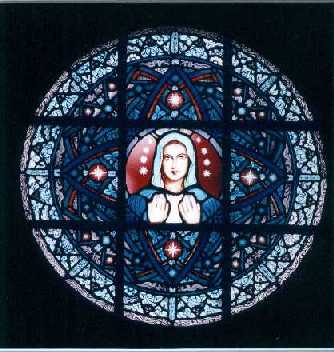 St. Mary Star of the Sea
What is the origin of the name of our parish, "Saint Mary
Star of the Sea"?
"Star of the Sea" is one of many of the titles of Mary. The
title comes from a type of prayer we Catholics have, called a
"litany", which comes from the Greek word for "supplication". A
list of the names of saints (or individual titles of a saint, as
in this case: 'Star of the Sea' is one title for Mary) is
recited, and the congregation replies "pray for us". Due to the
fact that this approach seems like a list, the word litany came
into English as a synonym for "list".
|
|
 St.
Mary Star of the Sea
St.
Mary Star of the Sea